Sunday, December 6, 2015

December 1987 Playboy Cartoon

Doug's cartoon was published in the December 1987 (p. 188) issue of Playboy.


To see more of Doug's Playboy originals, visit the Doug Sneyd Premium Gallery at:


(blog entries by Heidi Hutson)

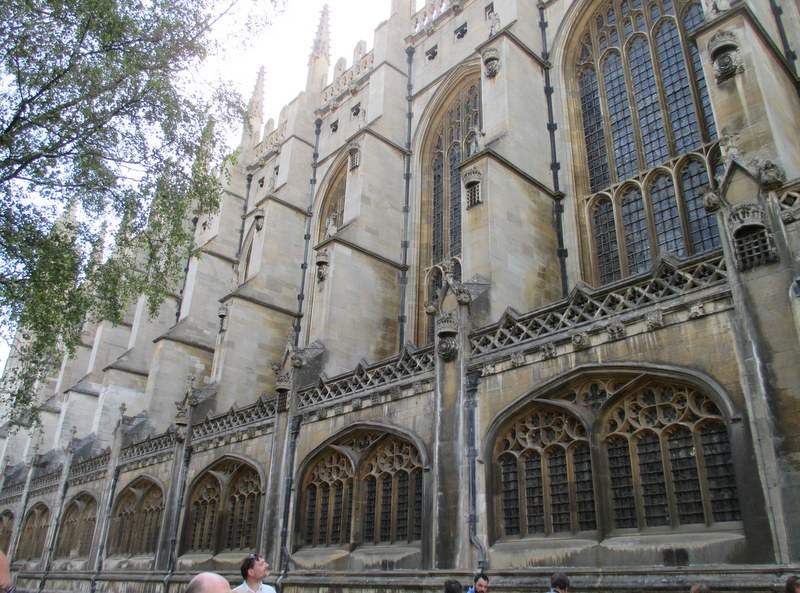
Quiet Sunday Morning in Cambridge

Cambridge, considered one of the top 5 universities in the world, is about 50 miles north of London.  

It's also the third oldest university in the world:  a group of scholars left Oxford and started Cambridge in 1209; it officially received a charter as a university from King Henry III in 1231.  It operates on a college system which separates the students into 31 established institutions scattered in the town of Cambridge, which Doug and I visited one Sunday morning - too early to see punting (riding in small boats) on the River Cam.


The Theory of Everything - the 2014 film celebrating the life of physicist Stephen Hawking - featured the historic city, the university and campus.  (Eddie Redmayne won an Oscar for playing the role of Stephen Hawking.)


One of the university buildings had a plaque recognizing Cambridge student Alan Turing, recruited to work at Bletchley Park to crack Nazi codes, including Enigma.


Doug and I visited one of the larger pubs in Cambridge:  The Eagle opened in 1667 as The Eagle and Child; it's owned by Corpus Christi College and managed by Greene King brewery.


Apart from the main bar and beer garden, the RAF bar (at the rear) has memorabilia of WWII airmen covering the walls and ceiling.


A flyer across from the entrance to The Eagle promotes a Mensa event.


Since it was Sunday morning, most of the activity was in the Market Square - not on campus.


It was helpful to check out the metal map (about a block from Market Square) for the location of university buildings throughout the city.


(blog entries by Heidi Hutson)

Bletchley Park: Thousands Work to Decipher Nazi Codes, Including Enigma

On our last day before leaving London to visit Cambridge/King's College and then Sandringham, Doug and I decided to take the train out to Bletchley Park.

In May 1938, Admiral Sir Hugh Sinclair, head of the Secret Intelligence Service (SIS or MI6), bought the Mansion and 58 acres of the Bletchley Park estate - 50 miles northwest of London - for use by GC & CS (Government Code and Cypher School) and SIS in the event of war.


Block B houses various exhibitions and galleries related to wartime Bletchley Park, including a slate statue of Alan Turig, the largest public display of Enigma machines in the world and an exhibition about the breaking of the Lorenz cipher.


At the peak of Bletchley Park's codebreaking operations, around 3,000 messages per day were brought to the GS & CS's top secret headquarters by dispatch motorcycles riders.


Equipment used for wireless interception in Block B.


Block C is now the Visitor Centre; however, during WWII, it housed the Hollerith punch card machines/tabulating machinery - a form of mechanical data processor that preceded the computer - that carried out analysis of enemy codes and cipher systems.


Steel, brick and concrete blocks were built on the property starting in 1941.


After leaving Block B, Doug and I walked around the lake to the Mansion, which dates back to the late 1870s.  During WWII, it served as the headquarters and recreation building.


Steps leading up to the Mansion (right side).


Griffins guard the Mansion entrance.


Library at the Mansion as it looked during WWII.


The Mansion at Bletchley Park was one of several locations used in filming The Imitation Game, which received 5 Golden Globe nominations and 8 Academy Award nominations - winning an Oscar for Best Writing, Adapted Screenplay.  (There were several film exhibition areas where visitors could pose for photos.)


One display in the Mansion featured props and costumes worn by actors Benedict Cumberbatch and Keira Knightley.


Reproduction of the bar at the Mansion.


Replica of the prototype Bombe machine Turig named Christopher.


Exhibition features Bombe blueprints and clothing worn by actor Benedict Cumberbatch, who was nominated for an Academy Award/Best Actor in a Leading Role.


(blog entries by Heidi Hutson)

Sunday, November 29, 2015

First Snowfall at Doug's Home/Studio

I thought I'd share photos after the first snowfall at Doug's home/studio in Orillia, which is 80 miles north of Toronto.  The 4" accumulation - Sunday morning, November 22 - was beautiful, but it made driving around the city a challenge for those without snow tires or 4-wheel drive.  

Local resorts like Horseshoe Valley - with 29 runs and over 45km of groomed cross country ski trails - now had a good base to "make" snow and open the slopes for skiing and snowboarding.

Main entrance (on left)/third floor is Doug's studio.


Photo was taken from Doug's back yard looking out over Lake Couchiching.


(blog entries by Heidi Hutson)

New Loose-Style 10 x 14 Original

In addition to using Dr. Ph. Martin's aniline dyes, on Arches of France cold press watercolor paper, Doug used india ink when rendering this newest 10 x 14 original.


To see more of Doug's originals, visit the Doug Sneyd Premium Gallery at:


(blog entries by Heidi Hutson)

How Doug Tests Aniline Dyes

Doug's worked in oils, pastels, watercolor, etc. over the years, but all of his full-page color Playboy cartoons - since the September 1964 issue - have been rendered using Dr. Ph. Martin's aniline dyes.  They give depth and translucency to his work but, as he cautions, they're "unforgiving" so he constantly tests his color combinations before going to final art.  

Initially, he mixes a few drops, from bottles of dyes, in divided fondue or deviled egg plates, adding a few drops of water to the dyes to adjust the intensity.  Then he tests colors on remnants of Arches of France cold press art board, naturally allowing time for the colors to dry.  From there, he can judge how he wants to proceed with the final art.


(blog entries by Heidi Hutson)